Key Findings
What clients, staff, and partner organizations told us about the Hub
This page brings together the key findings from the pilot data, illustrating how clients rated their experience on the client feedback survey, and what staff observed in their own post-visit reflections about what worked and what was challenging. Additionally, it highlights common themes for clients who engaged in the follow-up interviews with staff, addressing situational outcomes and the experience of actually reaching out to resources.
Client Satisfaction
At the end of each visit, clients were invited to complete a brief, optional feedback survey. 126 individuals completed the survey, and responses were consistently positive.
Did people feel taken care of?
On the client feedback survey, 96% of respondents said they felt supported by the staff (only 1 said they did not), and 93% would recommend the Hub to others.
“You guys were my light in that dark time.”
— Client, follow-up interview
“Very kind person, Noemi [a staff member at the Hub] — we thank you very much.”
— Client feedback survey (translated from Spanish)
Did people get what they needed?
In 83% of visits, Hub staff reported feeling able to connect the client to meaningful support. On the client side, 93% said they got helpful information (just 2 said they did not).
“Honestly, I wouldn’t have done it without you guys, because I didn’t know where to turn to.”
— Client, follow-up interview
“The staff always tries to support you and look for solutions.”
— Client feedback survey (translated from Spanish)
Did people understand their next steps?
86% of clients said they knew what to do next after their visit (only 1 said they did not), a sign that people left with clarity and a concrete path forward.
“They kindly informed me about all the opportunities I have. Thank you.”
— Client feedback survey (translated from Spanish)
What Staff Observed
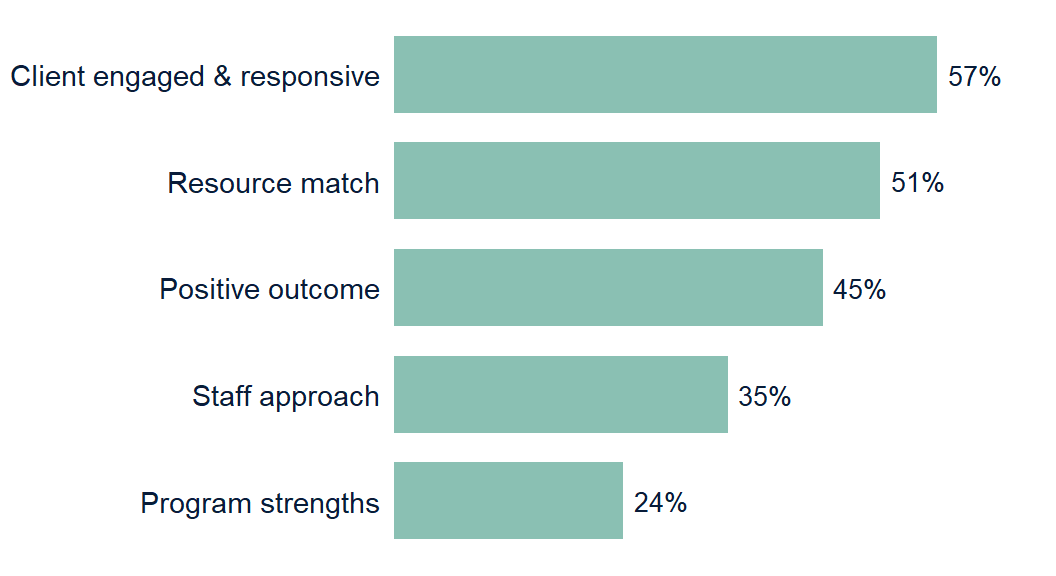
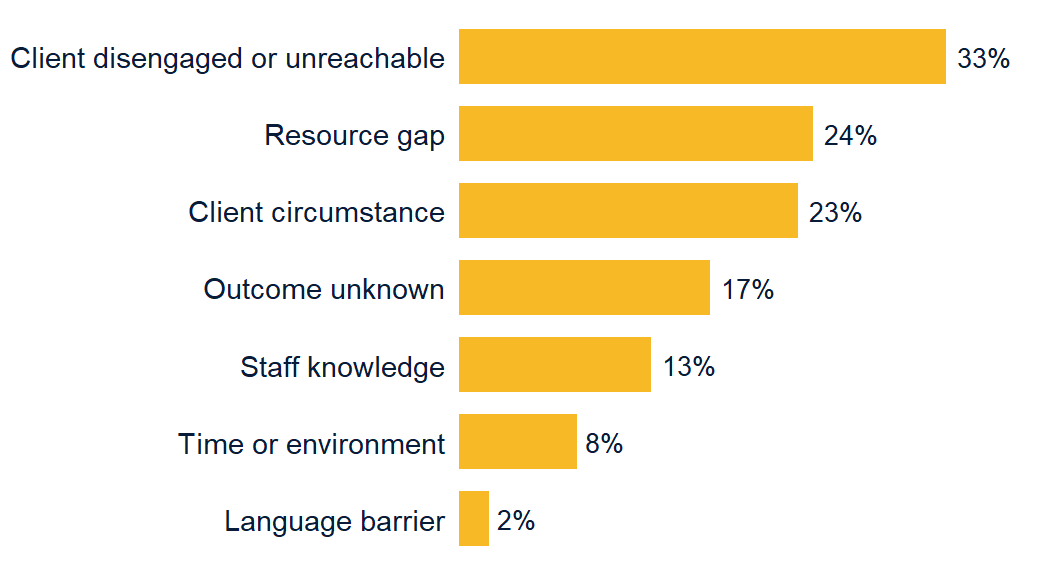
After each visit, Hub staff also recorded a short reflection on what worked and what made it hard to help. We coded those 230 recorded reflections into themes. Each bar shows the share of reflections in which staff named that theme at least once. Because a single reflection often touched more than one theme, the categories are not mutually exclusive and do not add up to 100%. The examples are drawn directly from staff’s words.
Client engagement is the throughline on both sides. When people stayed reachable and responsive, that engagement was the single most common ingredient of a successful visit; when they dropped off or could not be reached afterward, it was the single most common challenge. It tops both lists below, shown in its two directions.
What Worked
The most common successes staff described centered on client engagement and strong resource matches: people who arrived ready to engage, and a database that had the right connection on hand. One marker of that match: across the pilot’s recorded visits, staff were unable to offer a resource in only 9 cases; in nearly every visit, the Hub had something to connect a person to.
Common examples staff named:
- Client knew exactly what they needed
- Provided resources to client
- Collected client phone number for follow-up
- Client expressed thankfulness
What Made It Hard
On the challenge side, the recurring themes were client engagement (people the Hub could not reach for follow-up) and resource gaps (no available or eligible resource for the need).
Common examples staff named:
- Client did not respond
- Client did not respond to text messages
- Client did not follow up
- No rental assistance resources available
- Transportation barrier for client
- Unknown client location
Client Outcomes and Deeper Themes
17 follow-up interviews were conducted by the Hub staff with clients whose initial contact with the Hub was at least 30 days prior. Three key findings emerged from the analysis:
- Staff demonstrated compassion, empathy, and a welcoming, non-judgmental approach that clients consistently identified as setting the Hub apart from other organizations.
- The Hub provided more thorough resource connections than the traditional referrals clients had received in the past, sharing resources tailored directly to the client’s needs and providing technical assistance and follow-up throughout the process.
- While the Hub was highly effective at connecting clients to resources, gaps in the capacity of external service providers continued to be a barrier to clients receiving the help they needed.
1. A Compassionate Approach
Across interviews, clients frequently highlighted the warmth of the Hub staff as a defining feature of their experience. Staff were described as authentic, compassionate, and empathetic, which clients noted as lacking in their experience with other organizations. Clients mentioned feeling very comfortable discussing their needs with staff and as though they were treated like an equal. One community member shared: “You made it feel very comfortable, like we knew each other.”
This welcoming and communicative atmosphere stood in contrast to experiences clients described with other outreach efforts they had made outside of the Hub, where clients reported a lack of responsiveness from organizations or an unwillingness to help. The Hub was consistently described as rare in its level of responsiveness and care provided by the staff. One client emphasized her appreciation for the Hub’s services especially during a holiday, when most organizations operate with limited hours or are closed entirely.
“My son was with me and he said, ‘Wow, those are good people, mom. They’re the only ones that are talking to you today.’ Because he was there, I made like 20 calls. I was hysterical. I called anybody and everybody… You guys were the only ones that said ‘I’m going to try to help you and see what I can find for you.”
— Client, follow-up interview
“Your compassion, your empathy, and your resources… basically you were a hope on a golden platter for us. It was the little bit of strength, hope, and encouragement that I really needed. Your sincerity and your compassion is very loud and it’s very encouraging and that’s what we need. I got so many No’s.”
— Client, follow-up interview
2. Tailored Resource Connections and Follow-Up
Of the 17 clients interviewed, more than half reported at least some improvement in their situation since their initial contact with the Hub. These improvements included finding temporary housing, progress in housing applications, receiving immediate resource provisions (such as food, hygiene, and children’s items), completing education, and utility assistance. While root causes of instability, like unemployment or legal status, were not always resolved by the time of the follow-up interview, clients were able to address secondary issues that were significantly affecting their quality of life.
One of the most consistently praised aspects of the Hub was the speed and attentiveness in staff communication. Two clients specifically noted that staff replied within hours. Additionally, many clients noted their appreciation for the Hub’s proactive follow-up approach in which staff checked back in with clients, usually over text, to see whether additional assistance was needed. Clients described this outreach as both practically helpful, reminding clients to follow up on resources and providing contact information, and emotionally meaningful, making clients feel seen and genuinely cared for.
Texting in particular was highlighted by clients as an accessible and convenient mode of communication. One client explained that they weren’t always able to take phone calls or visit in person because they were in a loud environment, in transit, or in an appointment, so texting made it easier to continue the conversation.
Beyond communication, the Hub’s personalized, navigational role set it apart. Rather than handing clients a list of generic resources, staff made an effort to provide vetted resources that were tailored to their specific needs. As one client put it: “When you’re in crisis and need help, or are anxious anyway, you just can’t function. And that’s part of the need for assistance, just someone to help you just a little bit.”
“I tell everybody: if you need help or resources, come to this resource center… it’s convenient. If they can’t help you with something, they’ll give you a place to go.”
— Client, follow-up interview
3. Systemic Gaps
Just five of the clients identified the Hub as the first place they had reached out, meaning that clients had often sought help elsewhere before finding the Hub and had continued to seek help after. A majority of all clients interviewed were able to access at least one resource shortly after their initial interaction. Still, individual client outcomes were often mixed and the largest barriers for both the Hub and community members were systemic resource gaps and the limited capacity of external service organizations to provide help.
“You guys, out of everybody that I like emailed and stuff, they’re like, ‘Nah, we can’t help you. Like, no, no, no.’ But I feel like with you guys, doing the text message thing too, it’s a little bit more convenient.”
— Client, follow-up interview
Unresponsive or underfunded external organizations were a recurring theme across nearly all interviews, with many resources failing to return calls, lacking available funding (specifically for rental or utility assistance), or operating on waitlists and lottery systems. Eligibility restrictions based on geographic location, immigration status, or other documentation compounded these challenges. Across the interviews and staff’s post-visit reflections, immigration support was the area with the most notable gaps among Denver resources, preventing individuals from receiving rental support, employment, and food benefits.
A few clients remained in unstable or worsening situations despite the Hub’s assistance. Notably, two clients were unable to access any resources, one of whom already exhausted all known options, and another who was in acute crisis and unable to reach out.
When asked if they found the Hub helpful, one community member acknowledged the effort from Hub staff to provide multiple resource options and continued support; however, he was ultimately unable to get the help that was needed from other organizations and therefore it was not helpful in improving his current situation. Critically, staff responded reassuringly in the moment, acknowledging and sympathizing with the challenges and frustration expressed by the client, and coming up with a clear next step of calling additional resources to confirm their capacity to help before referring the client.
“I did get frustrated, but in all honesty, you guys were trying to do the best by giving me different places to go see. But it was more for me, like I wasted my energy and time… And yeah, it’s 50/50. From the way you were handling things, I had a feeling I would catch one that’s going to help me out because you do have a lot of options.”
— Client, follow-up interview
Notably, the pilot also surfaced early evidence of systems-level change: increased connections between the Hub and partner organizations, as is evident by the referrals to the Hub that came from these organizations, and a growing documentation of gaps in Denver’s resource landscape, such as immigration support and sufficiently available rental assistance funds or shelter space. These findings can support future efforts to invest in highly impactful resource areas and contribute to bridging the gaps in the community.
What Partners Told Us
Other organizations and service providers at the Westwood Community Center reflected on how the Hub has affected their work and the community. Their responses point to three things in particular.
The Hub acts as a central access point, connecting individuals and families to essential services such as housing, food, and healthcare – streamlining what can be a complex and overwhelming system so people can find the help they need. — A community partner
Staff have played a key role in filling service gaps that other organizations may not have the capacity to address, while fostering strong collaboration with partners across the center. — A community partner
A neighborhood-based, relationship-centered resource like the Hub makes support more trusted, accessible, and responsive. It meets people where they are, builds real relationships over time, and reduces barriers like transportation or stigma. — A community partner
Findings on this page draw on the client feedback survey, staff’s post-visit reflections, and partner reflection surveys. See About this Evaluation for methods.